Certified birth certificate translation for UKVI
Your certificado de nacimiento or partida de nacimiento, translated in full and certified to meet every element the Home Office asks for.
First page, no VAT to add
£34.95
+£28.00 each additional page
- A page is one side of A4, up to 400 words
- Certified PDF by the end of the next working day
- Signed, stamped certificate with online verification
- Posted hard copy, UK tracked £12.50
Price is per document, with no VAT to add. Same price whichever document it is.
Order your translationYou don't pay for it twice.
If the institution you named at checkout refuses it over the certification itself, send us their decision in writing and we redo it free — and if the second attempt still doesn't land, you get every penny back. 90 days from the date on your certificate.
- The whole document is translated, seals and stamps included.
- A real translator signs it — name and CIOL/ITI number printed on the page.
- Rejected on a certification point? We redo it free, then refund you.
Specific requirements for this document.
- The complete record: full names of the child and both parents, date and place of birth, and the registration details of the Registro Civil entry.
- The tomo, página and registry office identifiers reproduced exactly, so the entry can be traced.
- All stamps, seals, official annotations and marginal notes described in English — marginal notes often record later legal events and cannot be dropped.
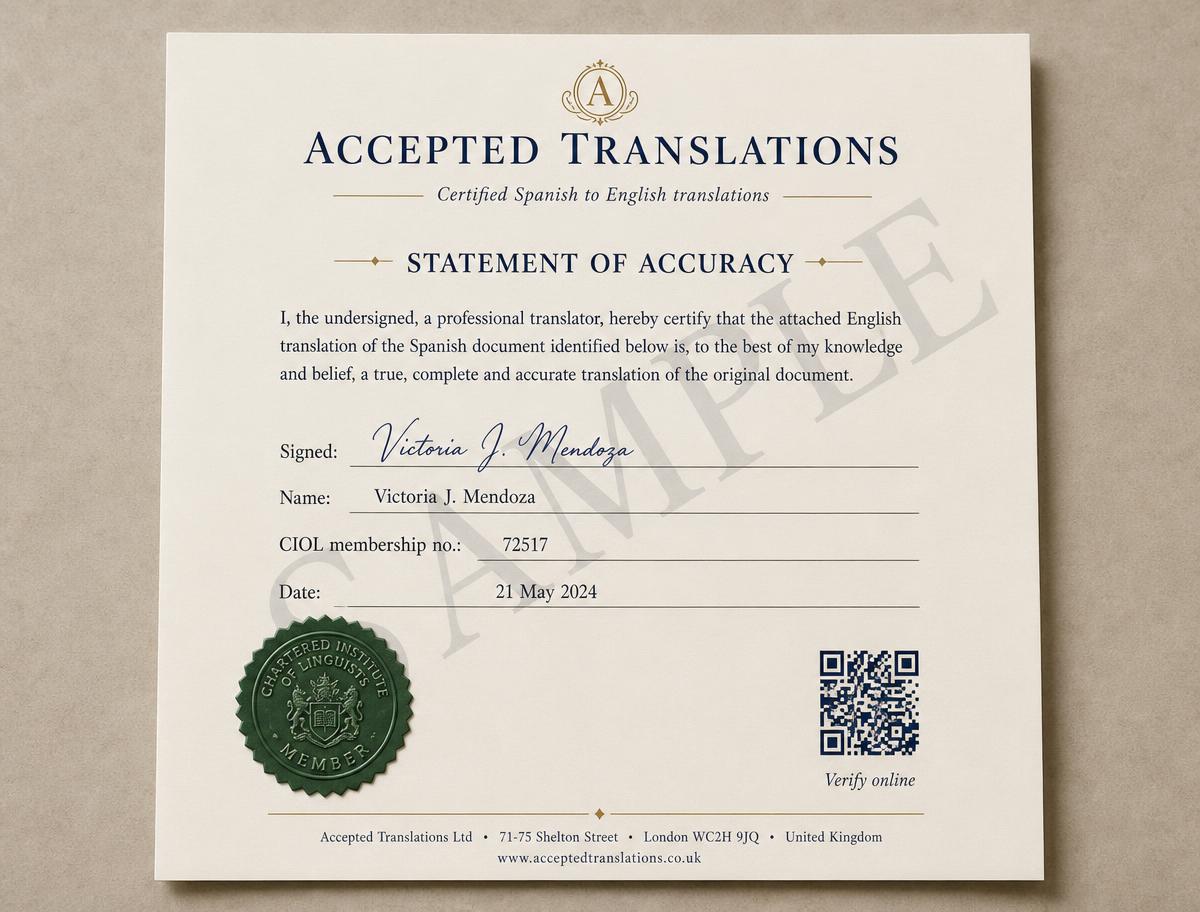
- A signed Statement of Accuracy with the date, the reviewer's name and signature, and our contact details: UKVI's four required elements.
Birth certificates go to caseworkers who read hundreds of them, and the checks are mechanical: does the translation cover the whole document, is there a statement of accuracy, is it dated, is the translator named and contactable. A translation missing any one of those is refused regardless of how good the English is. Every certificate we issue carries all four, plus a named reviewer with a checkable membership number and an online verification page.
The literal-form Spanish certificate (certificación literal) is the one most often required, because it reproduces the full register entry rather than a summary extract. If you have been asked for a birth certificate and you hold only an extracto, check the requirement before ordering — we can translate either, but only the issuing Registro Civil can give you the literal version.
Marginal notes are the part most often lost. A Spanish register entry can record a later name change, a recognition of paternity, an adoption or a nationality acquisition in the margin. Those notes are part of the legal record, and omitting them makes the translated document differ from the original in a way that a caseworker will treat as incomplete.
For UKVI, notarisation is not required and an apostille is a separate matter that concerns the original document, not the translation. If a receiving body outside the UK asks for either, tell us and we will arrange it rather than leaving you to work out the sequence.
And the certification itself
Whatever the document, the certificate that travels with it carries the same four elements UKVI asks for: a confirmation that it is a true and accurate translation; the date; the reviewer's full name and signature; and our contact details. On top of that it names the reviewing translator's professional body and membership number, and links to a verification page the receiving institution can check without contacting you.
Questions about this document
My certificate is decades old and handwritten. Can you still do it?
Yes. Older Registro Civil entries are routinely handwritten; legible text is translated and anything genuinely unreadable is marked illegible rather than guessed.
Do I need a certificación literal or is an extract enough?
It depends on the body asking. The literal certificate reproduces the whole register entry and is the safer choice when the requirement is not spelled out. We can translate either, but only the Registro Civil can issue the literal version.
The certificate has handwritten notes in the margin. Do they matter?
Yes, and they must be translated. Marginal notes record later legal events such as a name change or recognition of paternity. Leaving them out makes the translation incomplete and gives a caseworker a reason to reject it.