Certified translation in the UK: the rules, in plain terms
What "certified" actually means here, what UKVI and universities check, who is allowed to certify, and the two situations where you need something more than certification.
How we meet the rules below.
- A real translator signs it — name and CIOL/ITI number printed on the page.
- Your university can check it's genuine in about ten seconds.
- Rejected on a certification point? We redo it free, then refund you.
What the rules actually say
In Spain, a traductor jurado is appointed by the Ministerio de Asuntos Exteriores and their stamp carries legal authority. Britain has nothing equivalent: no state register, no Home Office licence, and no company can hold an official accreditation as a translator.
Because the UK does not certify translators, the rules govern the document instead. A certified translation is a complete translation of the original document, plus a signed statement from whoever produced it confirming that the translation is true and accurate. That is it. No special seal, no government stamp, no notarisation required for UKVI.
UKVI checks four things
When a certified translation accompanies a visa or settlement application, the Home Office looks for exactly four elements:
- A confirmation from the translator that it is a true and accurate translation of the original document
- The date of the translation
- The translator's full name and signature (or the translation company's)
- The translator's or company's contact details
The translation must also be of the whole document — partial translations, summaries and extracts are refused. If part of the original is illegible, the translation must say so rather than quietly omit it.
Who can certify it
Legally, anyone. Practically, the institution reading it will assess accountability: a named person, a company behind them, and a professional body that can be checked. Our certificates name the reviewer, their CIOL or ITI membership number, and our contact details, so the reader can verify who stands behind the translation.
Notarisation and apostilles
Notarisation is not on the UKVI list. It only confirms the identity of the person who signed the statement, not the quality of the translation. Some foreign consulates, courts and overseas universities ask for it — we can arrange it if you tell us before ordering. An apostille concerns the original document, not the translation, and is obtained from the issuing authority in Spain.
You don't pay for it twice.
If the institution you named at checkout refuses it over the certification itself, send us their decision in writing and we redo it free — and if the second attempt still doesn't land, you get every penny back. 90 days from the date on your certificate.
First page, no VAT to add
£34.95
+£28.00 each additional page
- A page is one side of A4, up to 400 words
- Certified PDF by the end of the next working day
- Signed, stamped certificate with online verification
- Posted hard copy, UK tracked £12.50
Certified translation
Accepted TranslationsRef
AT-4K9P-22
Document translated
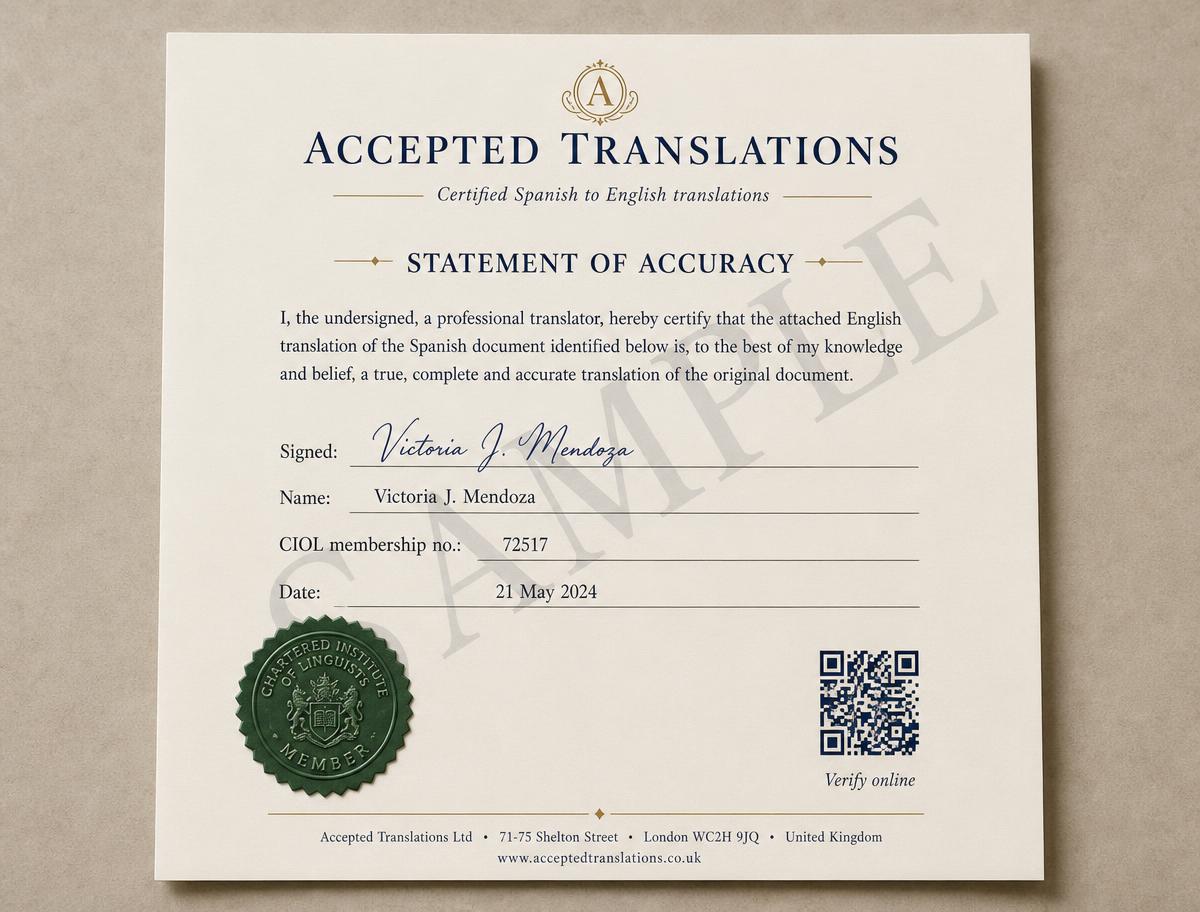
Statement of accuracy
I certify that this is a true and accurate translation of the original document seen by me.
Reviewed & signed
Named registered translator
CIOL / ITI membership
On the public register
Contact for verification
hello@acceptedtranslations.com
What our certificate contains
A redacted specimen of the certificate that arrives with your translation, field by field.
Common questions about certification
Is there such a thing as an official UK sworn translator?
No. The UK has no state sworn-translator system and no Home Office register of approved translators. Anyone may certify a translation, which is why the identity, credentials and contactability of the certifier are what institutions actually assess.
Does a certified translation need to be notarised?
Not for UKVI. Notarisation adds a notary's confirmation of the signatory's identity and is required only when the receiving body specifically asks for it — most often bodies outside the UK. An apostille relates to the original document, not the translation.
Can I translate my own documents?
No. A certified translation must come from an independent translator or translation company. A translation produced by the applicant or a relative fails the independence expectation even if the English is perfect.
How long is a certified translation valid?
The translation does not expire, but the underlying document might. A police certificate or a bank statement has a currency requirement set by the receiving body; retranslating an old document does not refresh its date.